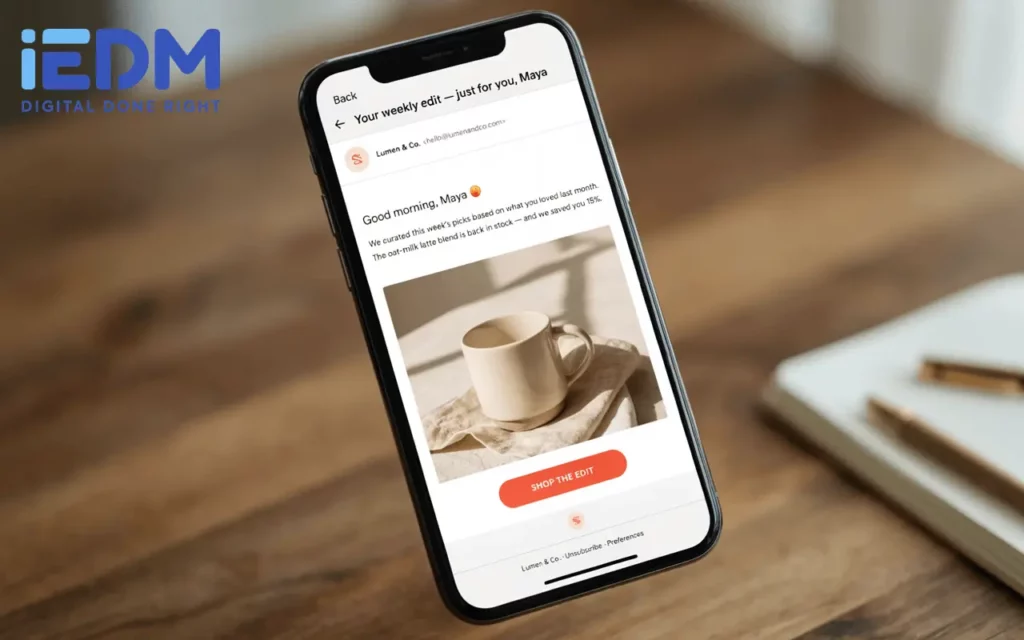
Email marketing in South Africa still works,so let’s look at why. Email marketing remains one of the most direct, cost-effective ways to reach the people who already know your brand. Not to mention, your customers are already checking their inbox; why wouldn’t you tailor a message to meet them there? Let’s dive into email marketing and see why it could be what your digital marketing strategy needs.
Want to find out if email marketing is right for your business?
What Is Email Marketing?
Email marketing is the practice of sending targeted messages to a list of subscribers via email. With this, your brand can build relationships, promote products or services, and move people through your sales funnel.
Unlike a social media post someone can scroll past without noticing, an email lands directly in front of the recipient and requires some form of action: open, delete, or ignore.
The content you send should shift depending on where someone sits in the customer journey. That might mean a welcome sequence for new subscribers, a product announcement for existing customers, or a loyalty offer for your most engaged buyers.
The common thread across every good email marketing strategy is relevance. If the content doesn’t resonate with the person receiving it, it won’t get results.
Why Email Marketing Should Be Part of Your Digital Marketing Strategy
A strong email marketing strategy does not replace your other channels. It works alongside them.
What a well-run Email campaign gives you
- The reader has to actively engage, rather than scroll past
- It is one of the most cost-effective digital marketing channels available
- It helps you build direct relationships with your customers
- It drives consistent, repeatable traffic to your website
- It allows you to segment your audience and speak to each group differently
- It lets you A/B test subject lines, content, and timing to find what actually works
- It gives you a direct, owned channel that isn’t subject to social media algorithm changes
Building and Growing Your Email List
None of the above works without a list of real, engaged subscribers. Here are our top 4 POPIA compliant ways of growing your email list:
- Offer something of genuine value in exchange for an email address, such as a discount, guide, or early access to a sale
- Use a signup form or pop-up on your website at natural points in the browsing journey
- Capture emails at checkout and in-store, with clear consent
- Make unsubscribing easy so the people who stay on your list are the ones who actually want to hear from you
A smaller list of engaged subscribers will outperform a large list of disinterested ones every time.
Segmenting Your Email Marketing Audience
Segmentation means dividing your subscriber list into smaller groups so each person receives content relevant to them. Common ways to segment an email list include:
Geography
For region-specific promotions or store-based offers
Demographics
To tailor tone and offers to different age groups
Purchase history
So you are not promoting products someone already bought or would never buy
Engagement level
So your most responsive subscribers get more frequent contact while inactive ones are re-engaged or removed
Expressed interests
Based on what someone has browsed or clicked on
Segmentation is what separates email marketing that feels personal from email marketing that feels like spam.
Email Marketing Automation
Automation is what makes email marketing scalable. Once set up correctly, an automated email marketing system reaches the right person, with the right message, at the right point in their journey, without you manually sending a single email.
Common Automation Triggers
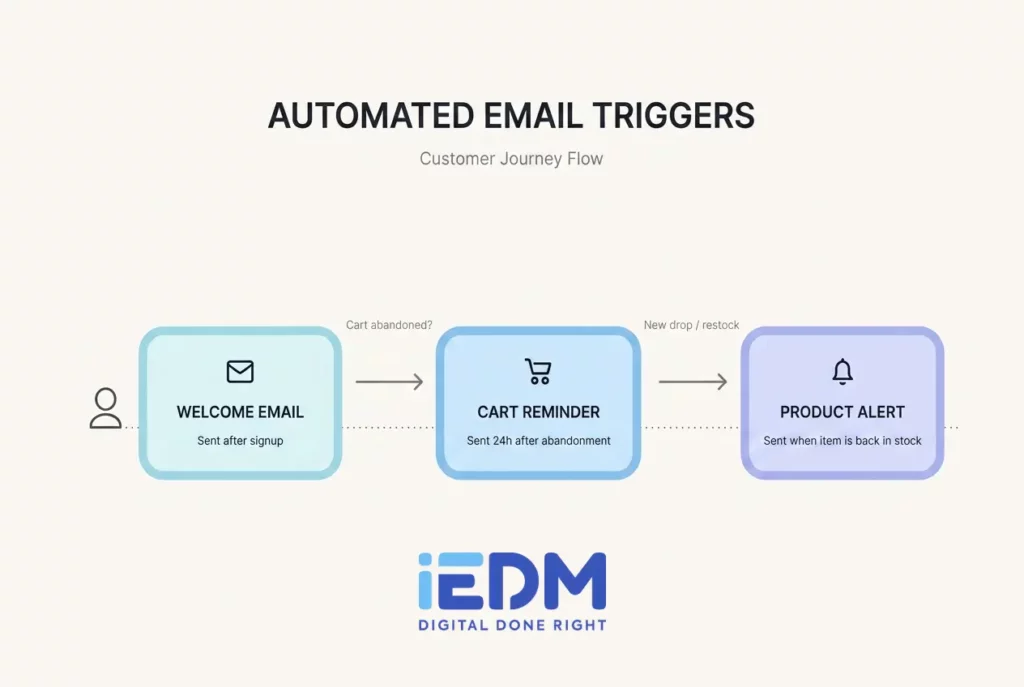
Automated email campaigns are built around triggers, meaning a specific action or date sets off a pre-written message.
The most useful triggers to set up include:
- Welcome messages, sent the moment someone subscribes or creates an account
- Cart reminders, sent when a customer adds items to their cart but doesn’t complete checkout
- Product alerts, sent when an item related to a customer’s interests or past purchases goes on sale or becomes available again
Track how each recipient responds. Did they open the email? Click through? Complete a purchase? This behavioural data feeds directly back into your next round of email marketing automation, making each campaign smarter than the last.
Email Marketing Personalisation, AEO and Brand Consistency
Consumers respond to messages that speak directly to them. A generic, one-size-fits-all email gets ignored. A personalised email marketing message – one that references a past purchase, a browsing pattern, or a specific interest – gets opened and acted on.
Personalisation now extends beyond using someone’s first name in a subject line. It’s about the story your brand tells being consistent, whether someone finds you through a Google search, a social media ad, or an email in their inbox.
This matters more than ever with the rise of AI-driven search and Answer Engine Optimisation (AEO). Since AI tools summarise and recommend brands based on how clearly and consistently they present themselves across the internet, you need to make sure your message and tone are consistent.
If your email content, website, and social channels all say different things about who you are, that inconsistency works against you. Both with customers, and with the AI systems that are increasingly shaping how people discover businesses.
Treat every email as one touchpoint in a much bigger brand experience, not a standalone campaign.
Other Benefits of Email Marketing Automation
Productivity
Manually emailing customers based on individual behaviour isn’t realistic at scale. Automation handles the repetitive work so your team can focus on strategy and content instead of sending emails one at a time.
Customer Retention
It is generally more cost-effective to retain an existing customer than acquire a new one. Automated, personalised email marketing keeps your brand in front of existing customers with loyalty offers, early access to new products, and requests for feedback that make them feel heard.
Scalability
A good email marketing platform lets you reach a growing subscriber base without a proportional increase in effort or cost. This matters most for small businesses trying to grow without ballooning overheads.
Email Deliverability, Spam and Unsubscribes
Getting your email marketing campaigns delivered to the inbox, rather than the spam folder, depends on a few consistent habits:
- Send from a recognisable, consistent sender name and domain
- Avoid spam-trigger language and excessive punctuation in subject lines
- Keep your list clean by removing inactive or bounced addresses regularly
- Only email people who have opted in
Unsubscribes are a normal part of running email marketing campaigns and are not necessarily a sign something is wrong. Common reasons people unsubscribe include receiving too many emails, content that no longer feels relevant, or simply a change in their needs.
What matters is watching the trend. A steady climb in unsubscribes or a consistently low open rate is a signal to revisit your segmentation, content, or send frequency.
Email Marketing Metrics and Reporting
Reporting is what turns a good campaign into a better one. Most email marketing software gives you access to metrics including:
- Audience and list details
- Successful deliveries versus bounced emails
- Open rates and click-through rates
- Number of unsubscribes and spam reports
- Forwarding and social sharing activity
- Orders or conversions generated from the campaign
- Geolocation of where emails were opened
Good open rates and click-through rates vary significantly by industry, so benchmark your own performance over time rather than chasing a single universal number. Use this reporting data to refine your subject lines, content, timing, and segmentation with every send.
POPIA and Email Marketing Compliance
The Protection of Personal Information Act, known as POPIA, governs how South African businesses may collect, store, and use personal data, and an email address falls squarely under this protection.
For your email marketing to be POPIA compliant, you need to:
- Get explicit opt-in consent before adding someone to your list
- Make unsubscribing simple and immediate
- Only use subscriber data for the purpose they agreed to
- Keep your data storage and handling practices secure
Compliance isn’t just a legal box to tick. It builds trust with the people on your list, which makes every campaign you send more effective.
Getting Your Email Marketing Strategy Right
Email marketing isn’t a channel you set up once and leave alone. It needs segmentation, personalisation, clean data, and consistent messaging that matches the rest of your brand presence: from your website to your social media.
Done well, it becomes one of the most reliable, cost-effective ways to nurture leads and keep customers coming back.
If building or refreshing your email marketing strategy feels like a lot to take on alongside everything else in your business, that’s exactly the kind of work we help with every day.
Let’s talk about what an effective email marketing strategy could look like for you.
Yes. Email remains one of the most direct and cost-effective digital marketing channels available, particularly for building long-term relationships with existing customers and nurturing new leads.
Yes, provided you have obtained proper consent from subscribers, offer a clear way to unsubscribe, and use their data only for the purpose they agreed to when signing up.
Email marketing is the broader strategy of communicating with subscribers through email. Email automation is a tool within that strategy, using triggers and workflows to send the right message at the right time without manual effort.
Focus on organic growth through genuine value exchanges, such as discounts or useful content, rather than purchasing databases. A smaller, engaged list consistently outperforms a large, disengaged one.