

Business Owners today need to know how to build an online presence that matches customr expectations today. South African customers have changed the way they find, research, and buy from businesses.
Most of that change is permanent. If your online presence does not reflect what customers expect when they land on your website, visit your social pages, or search for your services, you are losing them before the conversation even starts.
This is not a post-pandemic problem. It is a present-day business reality. The good news is that closing the gap between where you are digitally and where your customers expect you to be is entirely achievable with the right digital marketing strategy.
Not sure where your business stands online?
Why Digital Expectations Have Shifted
The 2020-onwards lockdown years accelerated something that was already underway. South Africans have moved online at speed: shopping, learning, communicating, and comparing businesses digitally.
What changed permanently is not the technology itself, but the baseline of what customers consider acceptable. A customer who can track a courier in real time now expects the same transparency from your business.
A person who can book a restaurant table, a doctor’s appointment, and a tax consultation online expects the same level of convenience from you. Your competitors, whether local or global, are setting the standard your customers use to evaluate your company.
What South African customers Expect Online Today
When a potential customer lands on your digital touchpoints (your website, your social media profiles, your Google Business listing) they are making fast, high-stakes judgements.
They expect:
- A website that loads quickly on mobile and is easy to navigate
- Consistent information across every channel (website, social, Google, directories)
- Personalised communication that speaks to their specific situation, not a generic audience
- A responsive contact point: live chat, WhatsApp, email, or a clear phone number
- Content that answers their questions before they have to ask
If any of these are missing or inconsistent, the trust gap opens immediately.
The Role of Personalisation in Digital Expectations
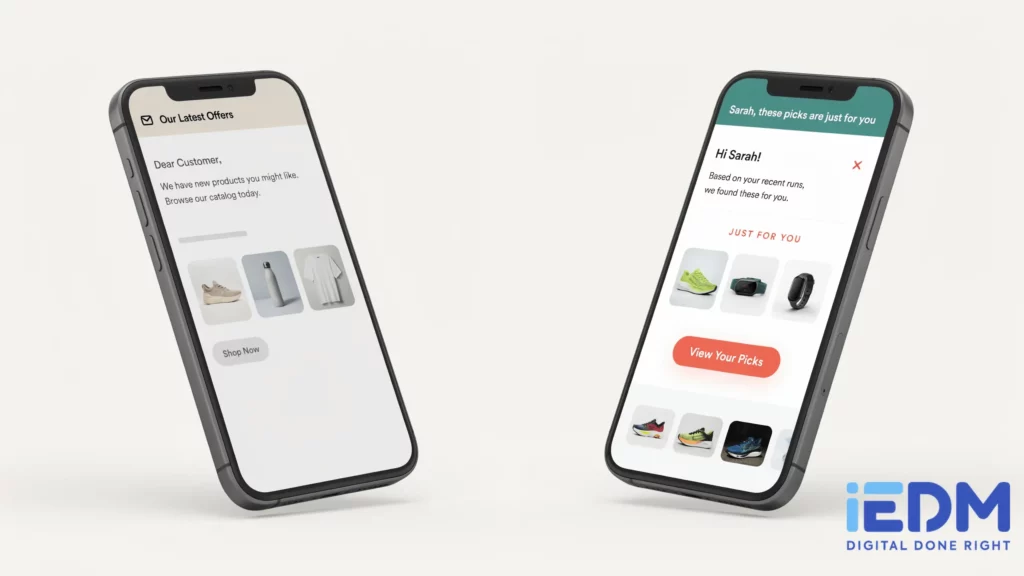
Personalisation is no longer a luxury reserved for large brands with enterprise marketing budgets. It is the expectation. When customers interact with your business online, they expect communication that feels relevant to them. They do not want to be part of a broadcast to everyone.
For small businesses in South Africa, this does not require expensive software. It starts with understanding your customers well enough to segment how you speak to them.
Practical Personalisation for Small Businesses
Your email marketing should speak differently to a new subscriber than to a customer who has bought from you three times. Your Google Ads copy should match the specific search term a person used. Your social media content should reflect the real concerns and language of your local audience, not a template lifted from a global brand.
When businesses get personalisation right, customers feel understood. When they get it wrong, or ignore it entirely, customers feel like a number. In a market as relationship-driven as South Africa, that feeling ends buying decisions.
Want to know more about why personalisation is critical? Read this article to find out more:
How to Build a Strong Online Presence for Your Business
A strong online presence is not a single thing. It is the sum of every digital touchpoint a customer encounters when they interact with your brand. Building it well requires consistency, clarity, and a strategy that serves the customer rather than just the algorithm.
1. Build or upgrade your digital storefront
For retail businesses, moving products online is the most direct route to reaching customers where they already are. But the opportunity is not limited to retail.
Virtual consultations, digital bookings, downloadable resources, and online courses have all become normal service delivery formats across industries.
Whether you sell physical products or professional services, your digital storefront needs to make the next step obvious. What does a visitor do when they land on your page? If the answer is unclear, that is the first thing to fix.
2. Make your online presence consistent across every channel
This is where many businesses quietly lose trust without realising it. A customer finds your business on Google, sees one phone number. They check your Facebook page, see a different one. They visit your website and find a service you no longer offer listed front and centre.
Inconsistency like this signals to customers, and to search engines, that your business is not actively managed. Conducting a simple audit of your business name, address, phone number, and service descriptions across all platforms is one of the highest-return actions you can take today.
3. Redefine your customer journey for a digital-first audience
Understanding your customer’s journey means mapping every step from the moment they become aware of your business to the moment they make a purchase and beyond. Online, that journey has more friction points than most business owners realise.
Where are customers dropping off? Which page do they leave without taking action? Are your contact forms working? Is your booking process straightforward on mobile?
A well-structured digital marketing strategy for small businesses in South Africa starts here , not with advertising. Rather, begin with removing the obstacles that prevent customers from choosing you in the first place.
Not sure where to start?
Use Data to Make Smarter Marketing Decisions
The advantage of digital marketing over traditional channels is that everything is measurable. Your website analytics show you which pages attract visitors and which ones push them away.
Your social media insights show you which content generates real engagement and which gets ignored. Your email metrics show you who opens, who clicks, and who unsubscribes.
Data sourced through your CRM, your website platform, and your social channels gives you a picture of what your customers actually want, not what you assume they want. That difference matters more than any marketing budget.
What to measure as a starting point
Focus on three things first:
- Where your traffic is coming from
- Which pages or posts lead to enquiries or purchases
- Where in the process are customers leaving?
These three data points will tell you more about your digital marketing strategy than any industry report.
Being Visible Where Customers Are Searching: SEO, Social and Beyond
Getting found online used to mean ranking on the first page of Google search results. That remains important… but where customers search is changing.
More South Africans are using voice search, social search (searching directly on platforms like Instagram or TikTok), and increasingly, AI-powered tools that surface answers without a traditional click.
A modern digital marketing strategy for small businesses in South Africa accounts for all of these channels, not just Google.
What this means for your online presence
Your content needs to do more than target keywords. It needs to answer real questions in a way that is clear, structured, and trustworthy enough for both a human reader and a search engine to consider it a reliable source.
This is the principle behind answer engine optimisation. Simply, structuring your content so it is the answer a customer finds, regardless of the platform they search on.
For South African businesses, this also means:
- Keeping your Google Business Profile updated
- Building a consistent brand voice across social platforms
- Ensuring your website clearly communicates what you do, who you serve, and where you are based.
Think Bigger Than Survival: A Digital Presence That Drives Growth
The businesses that built strong digital foundations in the last few years are not just recovering . They are growing.
A well-executed online presence has 4 main benefits:
The benefits of digital marketing extend well beyond awareness. Done well, it builds a pipeline of customers who already understand what you offer, already trust your brand, and are closer to buying before they even make contact. That is a fundamentally different starting point than a cold walk-in.
South African small businesses have every reason to invest in this. The tools are accessible, the audience is online, and the gap between digitally active businesses and those that are not continues to widen.
Ready to build a digital marketing strategy that works for your business?

What a Practical Digital Marketing Strategy Looks Like for South African Businesses
A digital marketing strategy does not need to be a lengthy document.
For most small businesses, it is a clear answer to four questions:
- Who are you trying to reach, and what do they care about?
- Where are those people spending their time online?
- What do you want them to do when they encounter your brand?
- How will you measure whether it is working?
From those answers, the tactics follow naturally. A business targeting professionals in Johannesburg and Cape Town may prioritise LinkedIn and Google Search. A lifestyle brand serving younger South African consumers may focus on Instagram and short-form video.
A local service business in Benoni or Pretoria may find Google Business and targeted Google Ads deliver the fastest return. The point is that strategy precedes execution. Without it, digital marketing spend becomes noise.
If you are not sure which channels make sense for your business, our team can help you map it out. You can also browse the IEDM blog for more guides on digital marketing strategy for South African businesses.
A Summary for Exceptional Online Presence
Your customers are already online. The question is whether they can find you, trust what they find, and take action when they do.
If any part of that journey is broken, contact the IEDM team and let us help you fix it.
A strong online presence means all consumer touchpoints are consistent, up to date, and present where your customers are searching.
For example your website, social media profiles, Google Business listing, online reviews, and any other platform where your brand appears
Start by identifying your target audience and where they spend time online. Then choose two or three channels that align with where those customers are. Set clear goals for each channel, track your results, and adjust based on what the data tells you.
Digital marketing gives South African businesses the ability to:
- Reach customers beyond their immediate geography
- Compete with larger brands
- Measure results precisely,
- Build relationships with customers across multiple channels.
A website is one part of your online presence. Digital marketing is the active strategy of driving the right people to that website and to all your other digital channels.


